
Reducing deforestation means getting serious about environmental crime
The Amazon Basin is approaching a dangerous tipping point.

The Amazon Basin is approaching a dangerous tipping point.

“This includes shining a light not just on crime groups and shady business but also the corrupt government officials – including police, notary clerks, customs officials, and politicians – who facilitate the business,” Szabó said in an interview with the Thomson Reuters Foundation.

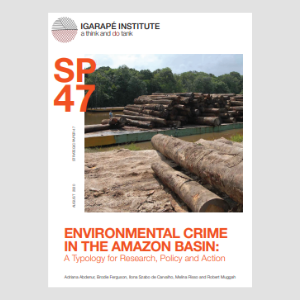
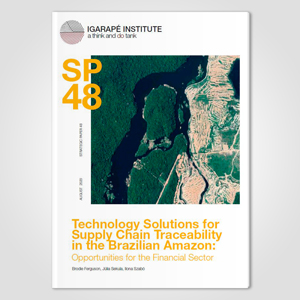
A new paper from the Igarape Institute – Environmental Crime in the Amazon Basin: a Typology for Research, Policy and Action – introduces a typology to help better understand the scope and scale of the problem and its extensive social and environmental impacts.

The articles in this volume explore how climate contributes to insecurity in the LAC region. They resulted from a partnership between the Igarapé Institute and the Instituto Clima e Sociedade (iCS), both in Rio de Janeiro, Brazil, with the support of the German Embassy in Brasília.

Coordinator of Igarapé’s international security division, Adriana Erthal Abdenur and researchers Lycia Brasil, Ana Paula Pellegrino, and Carol Viviana Porto launched the publication, Los delitos ambientales en la Cuenca del Amazonas: el rol del crimen organizado en la minería, in which they discuss the connections between environmental crimes and criminal organizations, especially regarding illegal mining.

Environmental defenders in Brazil are at risk — last year, 57 were assassinated and the numbers are increasing.

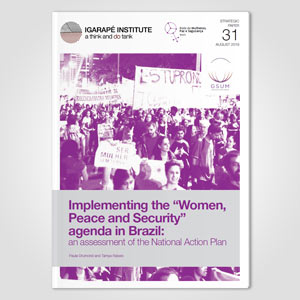
This article presents an analysis of the content of the National Plan of Action (NAP) on women, peace and security, a document adopted by Brazil on March 8, 2017, in response to United Nations calls for its member states to promote national strategies for implementation

While some world leaders resist global cooperation, city leaders are working across borders to tackle big issues like global warming, immigration and terrorism.

the Role of Climate Change in Recurring Violence Giovanna Kuele and Ana Cristina Miola The deadliest blast in Somalia’s history, which killed more than 350 people, and the double car bombing in Mogadishu last October represented frustrating backslides in the country’s efforts to build stability.

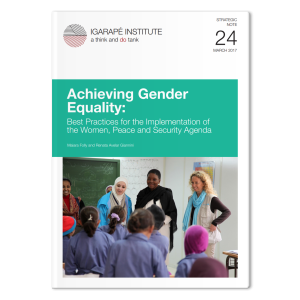
Esta Nota Estratégica tem como objetivo destacar boas práticas na implementação de diferentes planos nacionais de ação (PNA’s).
O Instituto Igarapé utiliza cookies e outras tecnologias semelhantes para melhorar a sua experiência, de acordo com a nossa Política de Privacidade e nossos Termos de Uso e, ao continuar navegando, você concorda com essas condições.