
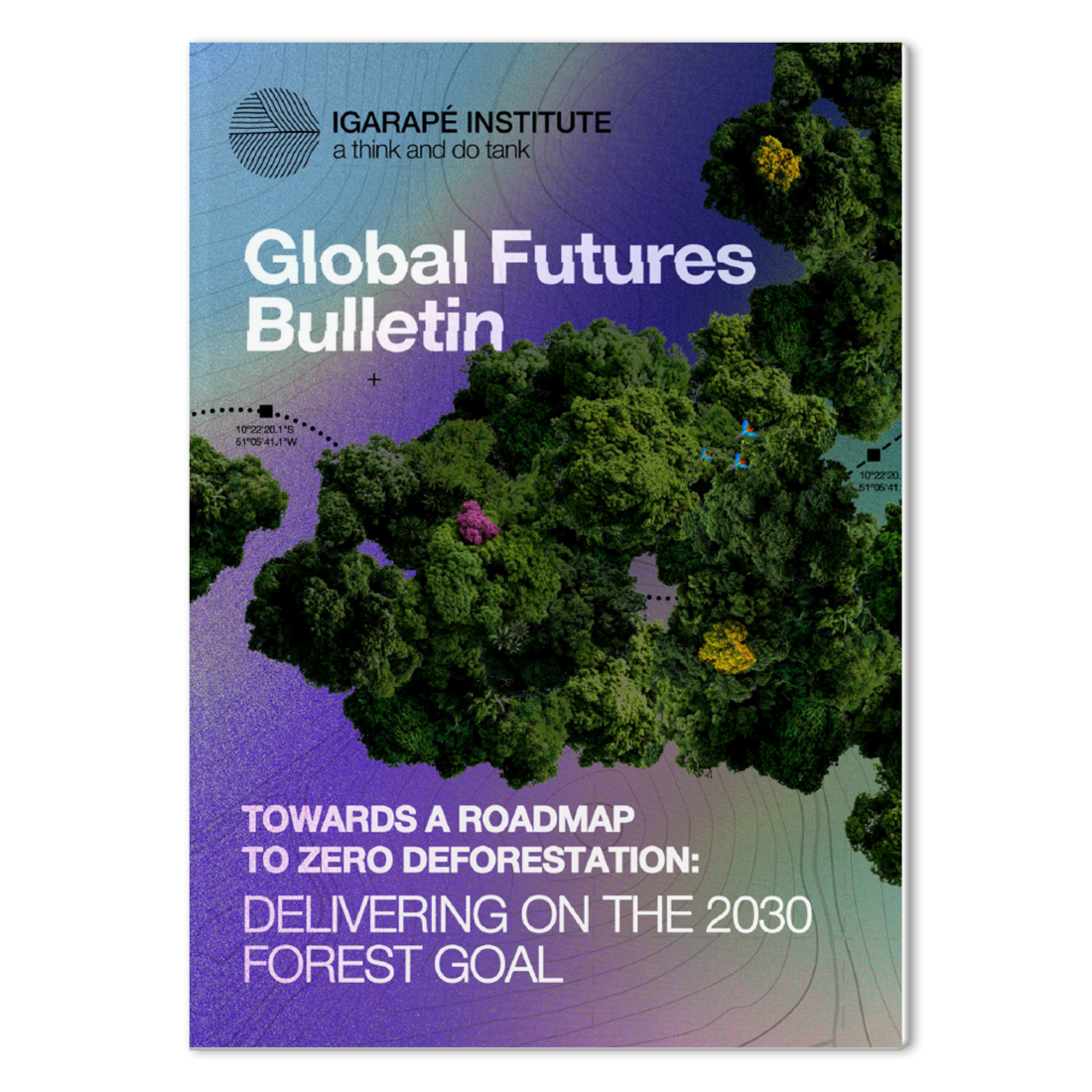
Towards a Roadmap to Zero Deforestation 3
The Igarapé Institute’s third Bulletin in the series maps the institutional ecosystem for the Forest Roadmap and proposes pathways for turning the COP30 commitment into concrete results by 2030.
Halting and reversing deforestation and forest degradation is a core pillar of the global response to climate change: fossil fuel use and land-use change, driven largely by deforestation, together account for virtually all anthropogenic CO₂ emissions. It was in this context that, at COP28 in Dubai, the first Global Stocktake (GST) under the Paris Agreement consolidated what this Bulletin refers to as the 2030 Forest Goal: halting and reversing deforestation and forest degradation by 2030. Two years later, at COP30 in Belém, this goal gained renewed political momentum with the announcement of a Roadmap dedicated to its implementation, alongside a second Roadmap on transitioning away from fossil fuels. Both are expected to be presented by the end of the Brazilian Presidency, at COP31.
Since the beginning of 2026, the Igarapé Institute has been publishing Bulletins tracking the development of this Roadmap. The first, Towards a Roadmap to Zero Deforestation: Inputs and Considerations, released in February, offered initial inputs for its design, drawing on Brazil’s experience in combating deforestation. The second, Towards a Roadmap to Zero Deforestation: Turning a COP30 Presidency Initiative into a Global Forest Platform, released in May, examined the institutional architecture needed to sustain the initiative beyond the COP30 Presidency.
This third Bulletin picks up where the second left off, mapping the institutional ecosystem already in place around forests, which brings together organizations, coalitions, financing mechanisms, and initiatives, and proposes pathways to activate it: strengthening coordination within the UN system, sustaining political momentum through a coalition of countries and other actors willing to lead the agenda, and translating the global commitment into regional and national implementation pathways.
With only four years left until 2030, the Bulletin points out that the Roadmap will only fulfill its role if treated not just as a document, but as a political platform capable of connecting and mobilizing this existing ecosystem. Sustaining the momentum generated in Belém beyond COP31 will be decisive in turning the goal into measurable progress by 2030.
Read the publication